


Overview
Flow Chart of Sculpted RMST design
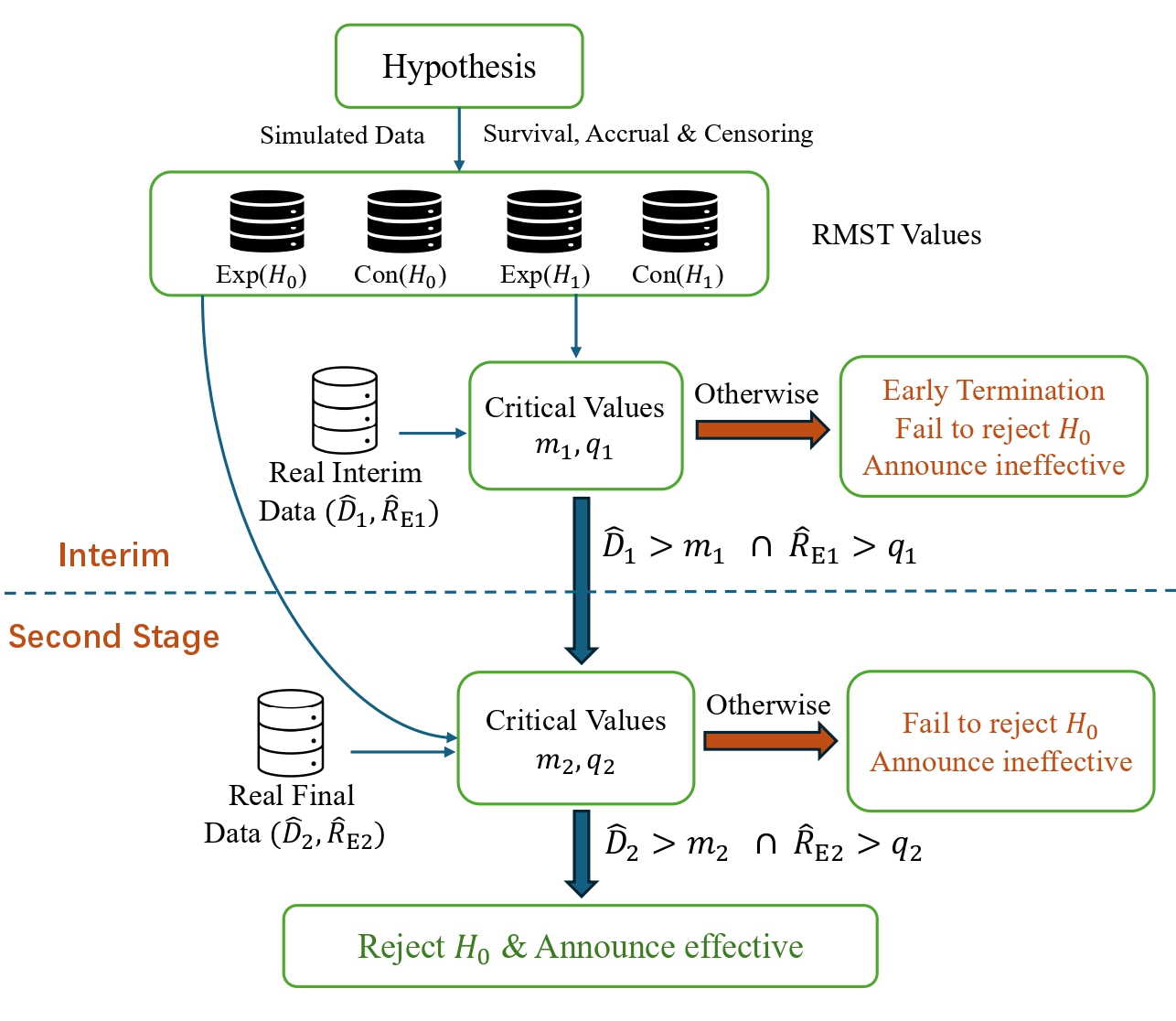
ScuRMST package is used for for Sculpted RMST Two Stages Double-arm Clinical Trial Design.
Sculpted refers to a defined critical region that necessitates both a significant difference in RMST between groups and a large absolute value of RMST in the experimental group in order to declare the treatment effective.
Further information of technical details can be found at GitHub repository
Installation
You can install the development version of ScuRMST from GitHub with:
# Install devtools if you haven't already
install.packages("devtools")

# Install ScuRMST from GitHub
devtools::install_github("garcia-ho/ScuRMST")
Due to the computational burdensome of simulation, many functions in this package are based on parallel computing using package Foreach and package doParallel.
Please register the number of cores first after importing ScuRMST:
# Set the number of cores as needed
set_cores(8)

# Return the current number of cores
get_cores

# Return the number of cores that available in your machine
n_cores <- detectCores()
Features & Examples
Given Total sample size N and interim sample size n
Example 1: Searching for the most powerful design (critical values) of Sculpted RMST under :
 sim_size <- 5000
 N <- 100
 r <- 60
 acc_time <- N / r
 cen_time <- 1
 lambda_H1 <- 0.9
 HR <- 1.7
 lambda_H0 <- 0.9 * 1.7
 change_time <- 1
 interim <- 0.6 * acc_time
 n <- ceiling(N / 2)
 alpha <- 0.05
 tau_f <- 2.5

 # Generate data for control arm (C) and experimental arm (E) under H0 and H1
 data_C <- expo_gen_2stages(N = n * sim_size, acc_time = acc_time,
                            lambda = lambda_H0, dist = 'exp',
                            cen_time = cen_time, arm = 0, interim = interim)
 data_E_H0 <- expo_gen_2stages(N = n * sim_size, acc_time = acc_time,
                            lambda = lambda_H0, dist = 'exp',
                            cen_time = cen_time, arm = 1, interim = interim)
 data_E_H1 <- expo_gen_2stages(N = n * sim_size, acc_time = acc_time,
                            lambda = lambda_H1, dist = 'exp',
                            cen_time = cen_time, arm = 1, interim = interim)

 # Calculate RMST data for interim and final stages under H0 and H1
 rmst_h0_int <- RMST_sim_cal(n = n, data_E = data_E_H0[ , c(2,3,1)],
                data_C = data_C[ , c(2,3,1)], tau = interim, sim_size = sim_size)
 rmst_h0_fin <- RMST_sim_cal(n = n, data_E = data_E_H0[ , c(4,5,1)],
                data_C = data_C[ , c(4,5,1)], tau = tau_f, sim_size = sim_size)
 rmst_h1_int <- RMST_sim_cal(n = n, data_E = data_E_H1[ , c(2,3,1)],
                data_C = data_C[ , c(2,3,1)], tau = interim, sim_size = sim_size)
 rmst_h1_fin <- RMST_sim_cal(n = n, data_E = data_E_H1[ , c(4,5,1)],
                data_C = data_C[ , c(4,5,1)], tau = tau_f, sim_size = sim_size)
 # Combine RMST data
 rmst_data <- rbind(rmst_h0_int, rmst_h1_int, rmst_h0_fin, rmst_h1_fin)

 # Calculate variance-covariance matrices under H0 and H1
 mu_cov_h0 <- mu_cov_mc(rmst_int = rmst_h0_int, rmst_fin = rmst_h0_fin, sim_size = sim_size)
 mu_cov_h1 <- mu_cov_mc(rmst_int = rmst_h1_int, rmst_fin = rmst_h1_fin, sim_size = sim_size)

 # Perform adaptive grid search for the best RMST design
 best_RMST <- adp_grid_src(rmst_data = rmst_data, mu_cov_h0 = mu_cov_h0,
                mu_cov_h1 = mu_cov_h1, int_n = interim * r, fin_n = 2 * n,
                alpha = 0.05, sim_size = sim_size, method = 'Complex')
Example 2: Searching for all suitable designs under , power > 0.8:
power <- 0.8
best_RMST <- adp_grid_src(rmst_data = rmst_data, mu_cov_h0 = mu_cov_h0,
               mu_cov_h1 = mu_cov_h1, int_n = interim * r, fin_n = 2 * n,
               alpha = 0.05, power = 0.8, sim_size = sim_size, method = 'Complex')
Example 3: Searching for the optimal design minimizing :
lambda_H1 <- 0.9
HR <- 1.7
lambda_H0 <- lambda_H1 * HR
sim_size <- 5000
r <- 60
cen_time <- 1
alpha <- 0.1
power <- 0.85
result_scu <- c()
# Give a searching range of total sample size N:
for (N in seq(from = 90, to = 92, 2))
{
    n <- ceiling(N / 2)
    acc_time <- N/r
    opt_rmst <- get_opt_des(n = n, sim_size = sim_size,
                acc_time = acc_time, cen_time = cen_time, int_step = 4,
                lambda_H0 = lambda_H0, lambda_H1 = lambda_H1, H1_type = 'PH',
                alpha = alpha, power = power, method = 'Complex')
    res <- our_rmst[, c('PET0','PET1','alpha','power',
                        'PET','EN0','EN1','EN','interim_n')]
    res$N <- c(N)
    result_scu <- rbind(result_scu, res)
    saveRDS(result_scu, "tem_result_scu.rds")
}

# All results are stored in result_scu
Contact
For questions, suggestions, or feedback, please reach out:
- Email: gaaisin@connect.hku.hk
- GitHub Issues: You can open an issue on the GitHub repository.